The "Main Theme": The DNA of a Soundtrack
How to compose less and compose better


The Blank Page Syndrome
When I composed the main theme for Manairons, I wasn't just writing a melody; I was searching for the game's musical DNA.
That significantly changed my approach to composition.
In a long soundtrack, it's easy to think you need dozens of distinct themes—a new one for every song, constantly starting from scratch—which often leads to creative block.
For a start, I preferred to focus my energy on one solid idea and build from there.
The main theme of Manairons isn't at all pretentious; it isn't epic, nor is it grandiloquent. It doesn't seek to impose itself.
It is simple.
A clear, almost fragile melody with restrained instrumentation. Few elements, but very well-defined. From the beginning, I knew I didn't want something spectacular, but rather something that accurately described the game's soundscape: small, mysterious, ambiguous, magical...
The theme plays in the main menu, upon opening the game, on the screen where you choose or load your save. It is the first auditory stimulus related to the game world. For me, it made sense for it to be the first thing you hear and for it to play in its entirety, on a loop, establishing a reference sound for the player.
From there, the work consisted of seeing how far that material could be stretched.
Not the entire soundtrack is built on leitmotifs; that wasn't the intention. There are two or three ideas that reappear at different moments (the main theme, the plaza theme, the witch's theme...), but there are also many thematic pieces for specific levels and bosses that function more autonomously.
The Manairons Sound
A Dual Sonic Identity
One of the most important decisions I made while composing this OST was not to rely solely on a symphony orchestra. Manairons is a classic tale, but it also has something industrial, almost uncomfortable about it, and that had to be reflected in the sound.
The orchestral base (woodwinds, strings, soft brass, symphonic percussion) represents the magical, the fantastic—that which connects to oral tradition, legend, and that small, mysterious world.
But the game also speaks of forced labor, production, exploitation... of repetition and machines.
That's where the electronic elements come in—not as lead synths or a "modern electronic" aesthetic, but as texture, an almost invisible layer. We find:
Processed noises reminiscent of engines.
Subtle metallic percussions.
Slightly distorted low-frequency pulses.
Ambiances with mechanical movement.
Often they are so integrated that you don't know if what you're hearing is processed percussion or an industrial sound effect, and that is intentional.
The orchestra draws you into the story.
The electronics remind you that this story has a crack in it.
This constant coexistence between the acoustic and the processed generates a very slight but permanent tension. And that tension defines the universe of Manairons just as much as any leitmotif. It is part of its soundscape.
Analyzing the Leitmotif
The Main Theme
The main leitmotif, which I will discuss next, is transformed when it appears at other moments in the game; it isn't a literal repetition. Sometimes only the melodic contour remains, sometimes it plays extremely slowly in a different melodic context, other times the harmony changes completely...
The ear recognizes it without the need for underlining, which creates something very subtle:
A sense of continuity, a sense of belonging.
The main theme Els petits no dormen mai directly references the legend of the Manairons: tiny beings who never sleep, never rest. In the wrong hands, their greatest virtue becomes their worst nightmare.
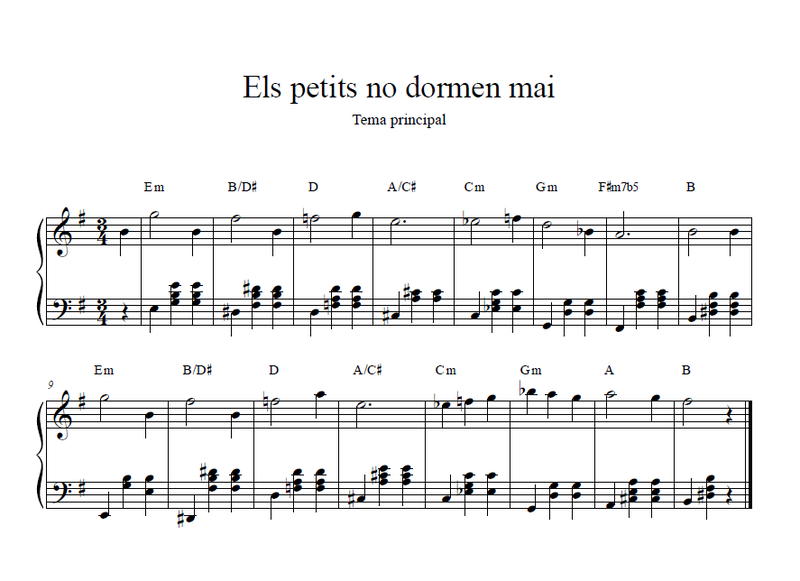
The piece is in 3/4 time (a waltz rhythm), 110 BPM, in the key of Em (E minor), and features a cantabile melody with some leaps, spanning a range (the distance between the lowest and highest note) of a ninth, from A3 to Bb4.
In the following figure, we can see how the melody makes an ascending leap of a minor sixth at the start and then follows a descending line. Halfway through, it repeats the same leap and descent, but at the climax, it traces an ascending line to the highest point of the melody before descending again toward the end.
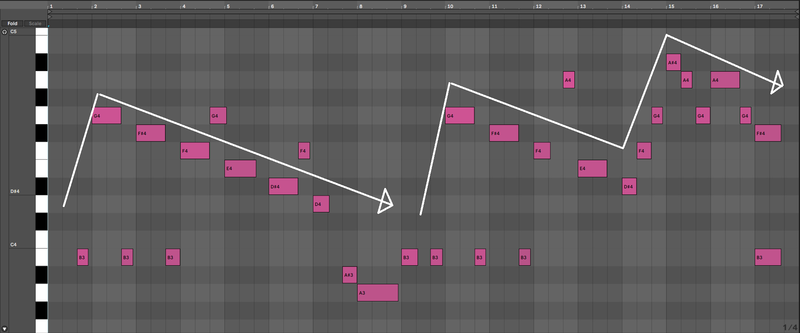
The melodic line depicts the Manairons' will to work without rest, with the first three leaps (B - G, B - F#, B - F) becoming smaller due to accumulated fatigue, followed by a period of forced labor expressed by the descending line. Halfway through, the melodic leaps (and energy) return, only to surprise with a climb to the very top when it seems no strength is left, followed by one last small descent to the end. This melody repeats 3 times in the piece and then indefinitely in a loop. It is a metaphor for the tireless yet suffering labor of the Manairons.
The harmony may seem quite tonal at first glance since it starts with the tonic followed by the fifth, but by the third bar, it already introduces a much more mysterious soundscape. This harmony also follows the concept of a descending line, as the bass of the song follows the notes E, D#, D, C#, C... the harmony accompanies the feeling of decay. The use of so many chromatic notes generates a sense of uncertainty and mystery that I felt was very appropriate for conveying the essence of the game. At the end of the harmonic sequence, the fifth degree reappears to reinforce that false sense of tonality and belonging to something stable before the loop restarts.
The harmony is: “Em B/D# D A/C# Cm Gm F#m7b5 B”. I thought it had enough personality to serve as a leitmotif for the soundtrack and applied it to other pieces, as I will show you below.
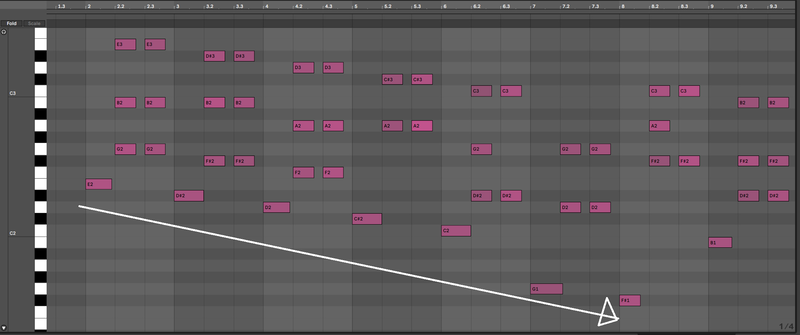
The waltz-style accompaniment gives the piece a childlike and harmless touch, providing that sensitivity worthy of a fairy tale.
Leitmotif Variations
The Story Song (or Cutscene Theme)
As I mentioned a moment ago, the following composition has the exact same harmony as the main theme. We are talking about Dins del canut, mil ordres, the piece heard when the game's narrator explains the story like a fairy tale. Let's listen to it and see if you can identify the harmony in question:
In this case, we have a piece without a clear melody, acting as ambient accompaniment. It is one of the few compositions in the game that is not a loop, allowing me to work on it in a more cinematic way.
It is also in Em (E minor), in this case in 4/4 time (unlike the previous one), and the key is that it is much slower than the main theme, at 53 BPM.
The change in BPM (beats per minute) and meter gives the harmony another dimension; in fact, it passes so slowly that it can be difficult to identify.
You can try humming the melody very slowly over the piece, and you will see that it fits perfectly.
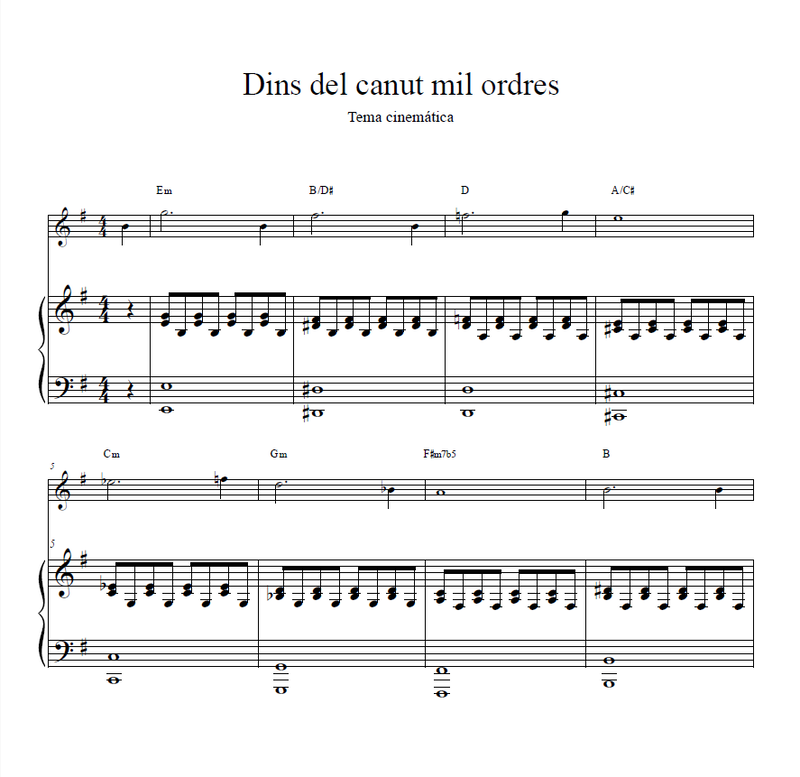
At this point, you might say: "Víctor, the two songs don't sound alike, and I don't really see how they're related..."
The key to using leitmotifs or self-referencing in an OST is exactly that: the player doesn't need to consciously perceive all the nods or strategies the composer has implemented for them to have value. Subconsciously, you are building a sonic identity, creating memories and references that contribute to the narrative and the emotional experience of the gameplay.
The Witch's Carriage
Another example, clearer in this case, of leitmotif development is heard when we first encounter the witch in her carriage, in the theme Uns ulls de faula. Before I tell you anything, let's listen to it:
In this case, the piece is in a kind of modal C major, 101 BPM, and in 3/4 time.
The melody sounds practically identical to the main theme, but in this case, we have two major differences: the instrumentation and, for me, the most important one, the harmony.
In this piece, we leave behind the chromatic feel of the main theme's harmony and dive into a completely modal harmony, dominated by a Lydian sound.
It is a sound that has been historically used in video game and film music to represent magic, wonder, fantastic worlds, exploration... and mystery.
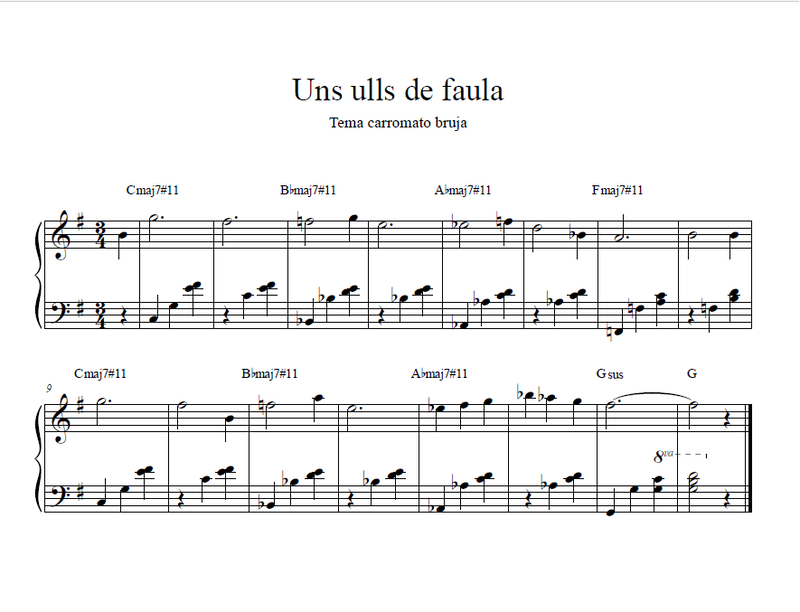
This harmony, combined with a more ethereal and less classical instrumentation, provides the exact point of ambiguity and doubt regarding this character who, at first, seems to guide your adventure toward success. Simultaneously, we have a clear sense of familiarity thanks to the piece's melody, identifying the witch as someone close who intends to help us.
L’encís del canut
There is one last theme that clearly references this leitmotif (and others), but I will save that for another time, once more weeks have passed since the game's release.
Conclusion
Working this way allowed me to spend more time developing the game's sonic identity instead of constantly generating new, disconnected ideas. Ultimately, leitmotifs are not some strange invention; they are a foundation, a starting point that helps everything else you create make sense and have coherence—and, ultimately, builds identity and narrative.
It's not about the player consciously detecting every reference; it's about them feeling, without realizing it, that everything belongs to the same world. So that when they hear a song from the video game, they think:
"This sounds like Manairons."

Comments
No comments yet. Be the first to comment!